

Agricultural outlook for Q2 2026 from Terrain®, our service for agricultural insights. Author Marc Rosenbohm is Terrain’s senior grain and oilseed analyst. This article originally appeared on TerrainAg.com.
Report Snapshot
Situation
While the Iran conflict has added upward pressure to wheat prices, both upside and downside price risk related to the conflict will remain in the quarter ahead. Spring weather forecasts and foreign supplies will also shape wheat prices.
Outlook
For Q2, I forecast hard red winter prices to remain in the mid-$5/bu. range and soft red winter prices to remain in the mid- to upper-$5/bu. range. I forecast spring wheat prices to rise to average between $6.30/bu. and $6.50/bu. in the 2026/27 marketing year.
Impact
Consider whether protecting against downside price risk fits into your risk management plan now that prices have moved higher than where they have been over much of the past quarter.
The price outlook for wheat broadly over the next quarter will remain heavily influenced by the Iran conflict, with spring weather forecasts and foreign supplies also contributing to the outlook. I expect significant volatility to continue, creating opportunities to market wheat over the next quarter as we move toward winter wheat harvest.
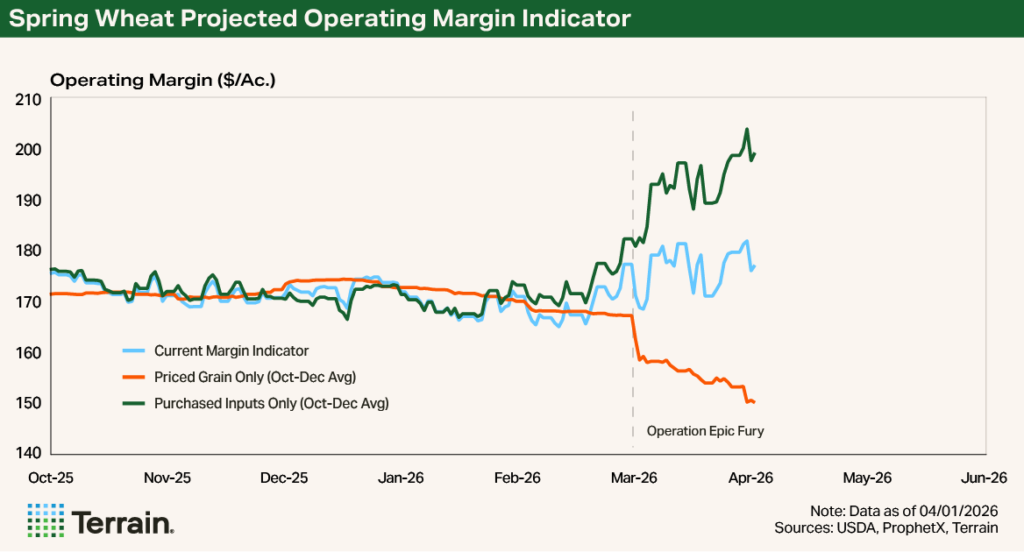
Despite this possible net improvement in operating margin for some, overall margin levels remain near break-even levels.
Epic Fury of Margin Volatility
The projected 2026 operating margins for spring wheat have been highly volatile since Operation Epic Fury began in Iran, with daily swings averaging $2/ac. (and up to $8.50/ac.). Yet they have remained largely in line with pre-conflict levels when comparing current expected prices to current production cost estimates.
Like other crops, the margin for any individual farm will depend on when inputs were purchased and when (or if) anticipated production has been priced. For those who purchased inputs before March 1, their margin has improved. For most farms, the outlook most likely falls somewhere in the middle.
Weather will continue to play an important role in the spread between U.S. wheat classes.
Drought Drags On
Weather will continue to play an important role in the spread between U.S. wheat classes. As of March 24, 57% of U.S. winter wheat is under some form of drought designation, with an additional 27% experiencing dry conditions.
Since the start of 2026, the first two drought classes (D0 and D1) have seen a noticeable increase while severe drought classes (D2 and higher) have remained relatively steady at 15% to 20% of winter wheat. Most of this increase has been in the hard red winter (HRW) growing areas of Kansas, Oklahoma and Texas, though wheat areas in the eastern corn belt and northern Mid-South also remain dry.
While parts of southern South Dakota remain under a drought designation, spring wheat areas north of that are forecast to be largely drought-free through planting.
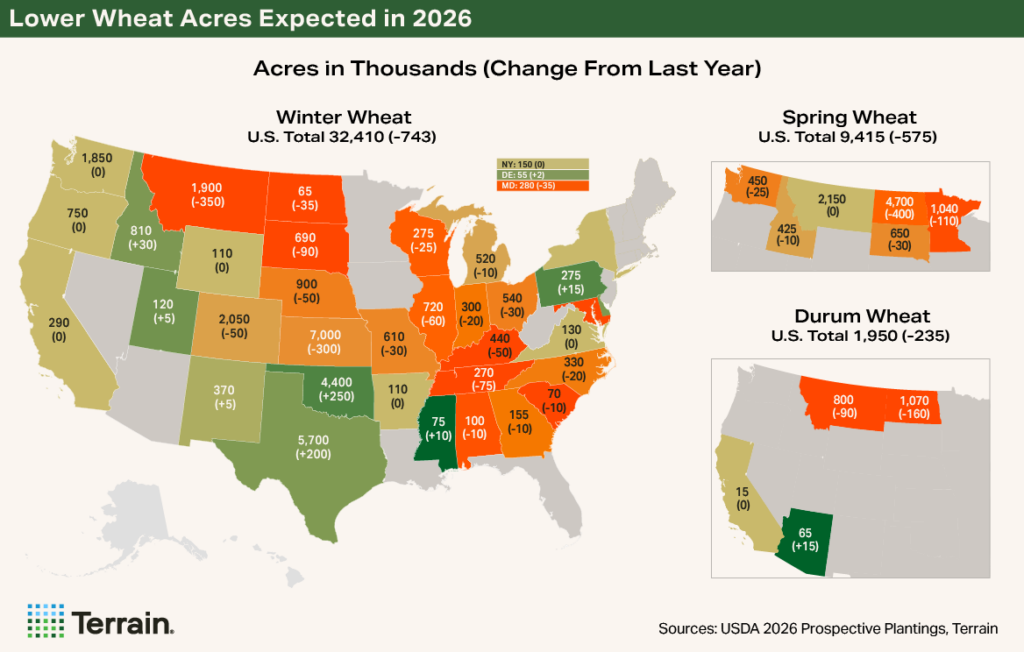
The USDA estimated in its March 31 Prospective Plantings report that farmers intend to plant 9.4 million acres of spring wheat, down 575,000 acres from last year. Durum wheat acres may fall by 235,000 acres to 1.95 million acres. Winter wheat planted area estimates were also revised lower to 32.41 million acres from 32.99 million in January.
Notable declines are expected in North Dakota and Montana, with a combined loss of over 1 million acres from last year across winter, spring and durum wheat. Notable gains are expected in Texas and Oklahoma, adding a combined 450,000 acres of winter wheat from last year.
Terrain® content is an exclusive offering of AgCountry Farm Credit Services, Farm Credit Services of America, Frontier Farm Credit, and American AgCredit.
While the information contained in this site is accurate to the best of our knowledge, it is presented “as is,” with no guarantee of completeness, accuracy, or timeliness, and without warranty of any kind, express or implied. None of the contents on this site should be considered to constitute investment, legal, accounting, tax, or other advice of any kind. In no event will Terrain or its affiliated Associations and their respective agents and employees be liable to you or anyone else for any decision made or action taken in reliance on the information in this site.


